
EYEWEAR E-COMMERCE
The Missing Number: Why Eyewear Shoppers Hit a Wall at Checkout
Most online glasses orders ask for one number the shopper has never been given. Here is what happens next, and what it does to conversion.
Buying glasses online begins as a purchase. It ends, for a lot of shoppers, as a small DIY engineering problem. Somewhere between picking the frames and entering the prescription, the order asks for a number the shopper has never been told. Pupillary distance. The distance between the centres of the pupils, in millimetres. Most shoppers do not have it. Most prescriptions do not include it. And the order will not move until it appears.
For anyone running buying glasses online as a business, the PD field is one of the quietest abandonment points in the funnel - a checkout question dressed as a measurement, asked at the worst possible moment, of the one person least equipped to answer it.
In eyewear e-commerce, the first measurement step often happens not in the optician's chair, but at checkout - on the customer's phone, alone.
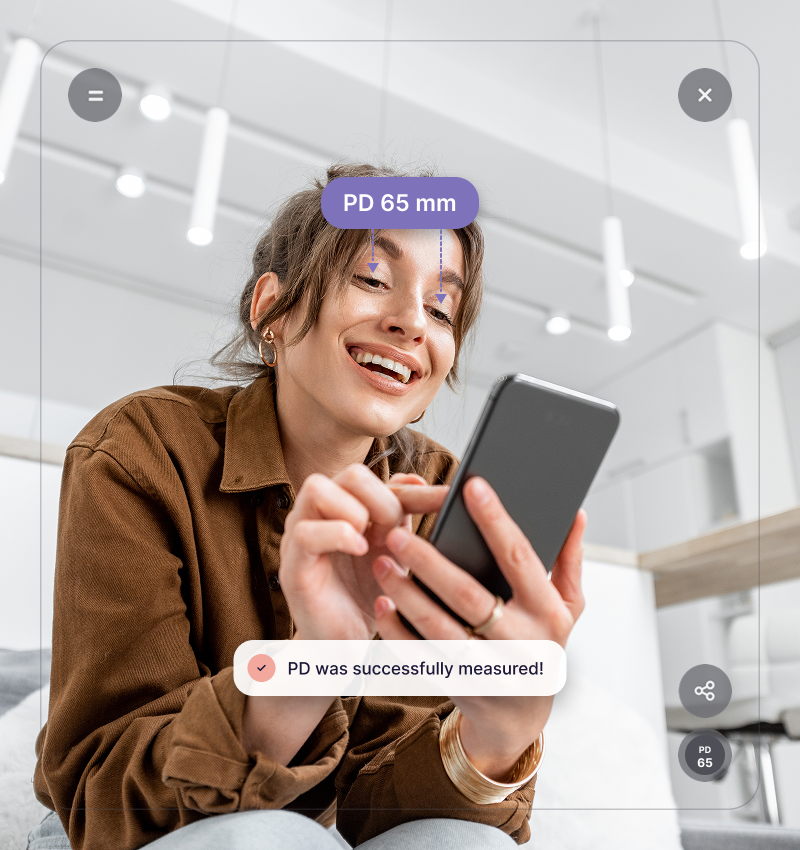
The missing step at checkout
The pattern is consistent across eyewear shopping communities online. A shopper finds a pair of glasses they want. They reach the prescription page. They are asked for their PD. They look at their prescription. The number is not there.
What follows is not a journey their store designed. It is improvised. They call the doctor's surgery and hope someone answers. They print a ruler off the internet. They download an app. They open the camera and hold a credit card up against their nose. They ask their partner to measure them with the ruler from a kitchen drawer. They take three readings. The readings disagree.
This is the moment most online eyewear stores quietly lose the customer. Not at price, not at choice. At a single field that turned the order into homework.
Why the methods don't agree
There are at least four ways a shopper can try to find their own PD: ask the optician who measured it (if they did), use a paper ruler against a mirror, use a phone app that scans a selfie, or use a printed credit-card guide. Each method makes different assumptions about what the camera sees, where the pupil is, and how steady a human hand is. They produce different numbers from the same face.
Four ways to measure. Four different numbers. One order.
These patterns come from eyewear shopping communities and public style discussions reviewed through May and June 2026 - the same observational method behind every Auglio FrameIndex.
That is the structural problem. The store is not asking for a difficult fact. It is asking the shopper to be their own optician, with whatever tools they can find, in the middle of a checkout flow. The answer they produce is the answer the lenses get cut to. There is no margin for the shopper to be wrong, and every chance they will be.
Brands that close this gap - measuring the PD for the shopper from a standard camera, accurately, inside the same flow they are already in - typically see conversion lift of 15 to 30 percent based on observed industry patterns, because the lift comes from shoppers who would otherwise have walked away during the form.
What shoppers actually do
The voices repeat. Across the communities where shoppers go for help when their store cannot give it, the same scenes play out.
“I need to call the Dr back tomorrow and see what my PD is because he didn’t put it on my prescription.”
– Eyewear shopping communities online
That is the start of the journey, hours after the order page has been left open. The doctor has the number. The shopper does not. The order waits.
“This is so frustrating… I used an app. Then I used a ruler then my wife used a ruler on me and the numbers were different each time.”
– Eyewear shopping communities online
That is the middle. The shopper, given no help by the store, builds their own measurement workflow. It tells them different things. They have to pick one and hope.
“I recently purchased glasses from JINS in Japan… they measured my PD as Right 34.5 and Left 33.0. However, when I received my glasses, the Rx they provided says that the PD is 30 on each side.”
– Eyewear shopping communities online
That is the end. Even when the PD was measured, the number that arrived in the lenses was not the number that was taken from the face. A few millimetres of error from a clinical setting. Several millimetres of error from a kitchen.
What the communities show is not a fringe failure mode. It is the standard journey for a shopper who reaches the PD field unprepared. The store framed PD as a small extra detail. For the shopper, it is the moment the purchase stopped being a purchase.
What this means for e-commerce conversion
The PD field is invisible in a conversion funnel because it sits inside what looks like form completion. A session reads as engaged. A cart reads as warm. A shopper opens the prescription page, sees the question, leaves the tab open, and does not come back. Or comes back two days later with a number they are unsure of, places the order, and starts a thread asking strangers whether the glasses they just bought will give them a headache.
The damage shows up in three places at once. Abandonment in the form, before any payment intent is given. Order errors when the shopper enters a number they are unsure of. Returns and remakes when the lenses are cut to the wrong centres and the world goes slightly off.
This costs something at every price point, and the cost climbs with it. A shopper unsure about a 40 GBP frame may still take the chance. A shopper unsure about a 400 GBP frame usually will not - they defer, they ask a forum, they walk to a physical store, or they abandon the order rather than spend that much on a measurement they did themselves with a printed ruler. Every retailer loses some shoppers to the PD field. The premium retailer loses the most valuable ones.
Shoppers are not failing the prescription page because they do not want glasses. They are failing it because the page is asking them for an answer they were never given.
The stores quietly winning this part of the funnel are not asking the shopper for a PD at all. They are taking it from the camera the shopper has already opened for the virtual try-on, in the same flow, with no extra step and no physical card. The friction does not exist for those shoppers. Neither does the doubt.
Three things to check in your store this week
- Open your store on your phone and reach the PD field as a first-time customer.
Without using outside knowledge, see how the store guides you. Does it tell you what a PD is, before asking? Does it offer a way to measure it without leaving the order? Does it accept “I do not know” without ending the session? If you cannot find a clear path in thirty seconds, your shoppers cannot either - and they are not telling you, they are leaving.
- Audit how PD is requested across your top three traffic sources.
Mobile, desktop, paid social. The PD ask often sits in a different place on each. Find the worst version. That is the one most of your customers see.
- Segment your abandonment by form-step.
Find the shoppers who reached the prescription page and left without continuing. That cohort is the PD cohort - not low-intent, not browsing for fun. They were ready to buy and the form asked them a question they could not answer.
The brands that close this gap take the PD out of the customer's hands and put it back where it always belonged: inside the experience the store provides. Fewer abandoned forms, fewer wrong numbers, fewer remakes - and a measurable lift on a step nobody used to measure.
Want to see how Auglio takes PD out of the customer's hands?
→ Book a demo at auglio.com/en/contact
Tags: Eyewear E-commerce conversion Eyewear e-commerce Buying glasses online PD measurement Auto-PD