
May 12, 2026
Eyewear E-Commerce · Product Insight
The Shape Question: Why Most Eyewear Shoppers Answer It by Leaving
Every shopper asks one question before they buy glasses online. And most of the time, they answer it by leaving.
Most eyewear shoppers know the rules.
They have read the guides. Round faces suit angular frames. Square faces soften with curves. Long faces benefit from depth at the lens. The information is everywhere - on retailer sites, in style magazines, in the friendly graphics opticians use to walk first-time wearers through their options.
The rules are not the problem.
The problem is what happens when the shopper looks in the mirror and tries to apply the rules to the face looking back.
This is what we call the Shape Question - the silent moment, before any product is selected, when an eyewear shopper asks themselves what will actually look right on their face. It is the most important moment in the entire online eyewear journey, and it is the moment most online stores have left the shopper to navigate alone.
In eyewear e-commerce, the gap between knowing the rules and applying them to oneself is not a literacy problem. It is a translation problem - and it is where the highest-intent shoppers quietly disappear.
The Hidden Drop-Off
There is a moment that happens before any frame is added to a cart, before any virtual try-on is opened, before the shopper has even narrowed down to a style category. They land on a product page, or a collection page, or a recommendation grid, and they look at the frames on offer. Then they look, in their mind, at their own face. And they cannot bridge the two.
This is the moment most online eyewear stores cannot see. Conversion analytics treat browsing as engagement. Bounce metrics treat short sessions as low intent. Neither captures the shopper who has spent twenty minutes scrolling through frames, tried to picture each one on themselves, and given up - not because they did not want glasses, but because they could not answer the most basic question the purchase requires.
Translating between the generic rules of frame style and the specific reality of one's own face is harder than the category admits. The shoppers who navigate this on their own are the ones with years of eyewear experience, or an optician in the family, or who simply do not mind taking a guess. Everyone else half-decides and abandons.
Why do most eyewear shoppers leave before they even try anything on?
Because they cannot do the translation work alone, and the store has not done it for them.
Across eyewear shopping communities online, a specific behaviour appears month after month. A shopper posts a selfie. They list the three or four frames they are considering. They ask strangers to interpret what they cannot interpret for themselves. "What glasses would look good on me?" "Do any of these look good on me?" "I've gotten mostly good feedback but I swear I don't believe it - think it ages me?" The shopper is not asking which frames are good frames. They are asking what their own face says about which frames are good frames for it. That is a different question entirely, and it is the one no online store currently answers for them.
"Not really sure what my face shape and features are, so I'm not sure what to look for in frames." - Eyewear shopping communities online
This is the literacy gap stated in the shopper's own voice. Two layers of uncertainty in a single sentence. They do not know their face shape. They do not know what to look for as a result. The chain breaks at the first link, and everything downstream - the filter, the recommendation, the try-on - cannot recover what was lost at the start.
Shoppers are not learning their way past this. The information they need to translate the rules into their own decisions is not in the place they look for it. So they ask the community, or they ask the void, or they close the tab.
This is the silent reason eyewear shoppers abandon sessions before they ever engage with a virtual try-on.
This pattern is most acute in premium eyewear. A shopper hesitating over a 40 GBP frame might guess and live with the result. A shopper hesitating over a 400 GBP frame will not commit to a guess, and they will not believe a recommendation that does not show them why. This kind of work cannot be implied. It has to be done explicitly, and it has to be done for them.
Why does this problem go unmeasured in eyewear e-commerce?
Because the drop-off happens at the stage every analytics platform treats as success.
Browsing looks like engagement. Time on page looks like interest. A shopper who spends six minutes looking at twenty frames before leaving looks identical, in the dashboard, to a shopper who spent six minutes comparing two frames before purchasing one. The first is paralysis. The second is decision. Most retailers cannot distinguish between them, so they treat the paralysis as a partial win - the shopper looked, the shopper saw the catalogue, the shopper might return.
Most do not. The shopper who could not answer the Shape Question for themselves rarely comes back to answer it on a different day. The cognitive load does not lighten with a second visit. If the store could not help on Tuesday, it cannot help on Saturday.
There is a second-order effect worth naming. Shoppers who push through the Shape Question without answering it confidently are the shoppers who buy with uncertainty. They pick the frame that looked best on the model in the photo. They guess at sizing. They commit to a 200 GBP purchase based on a half-formed mental image of themselves wearing it. And then they open the box, and the gap between what they imagined and what arrived is what shows up in the returns queue. Industry estimates put online eyewear return rates at 15 to 20 percent, with fit and style mismatch the dominant reasons. The Shape Question goes unanswered downstream as well as upstream.
Browsing without buying is not always a soft conversion signal. In eyewear e-commerce, it is often the sound of a shopper trying to answer a question the store has not helped them with.
How does the future of online eyewear actually solve this?
By stopping the work of showing inventory, and starting the work of doing the translation.
The future of buying glasses online is not better virtual try-on. Try-on is downstream. By the time a shopper opens the try-on, they have already done the hardest part of the journey - they have decided which frames are worth trying on. The shopper who cannot answer the Shape Question never gets that far. Improving the try-on does nothing for them. They left before it loaded.
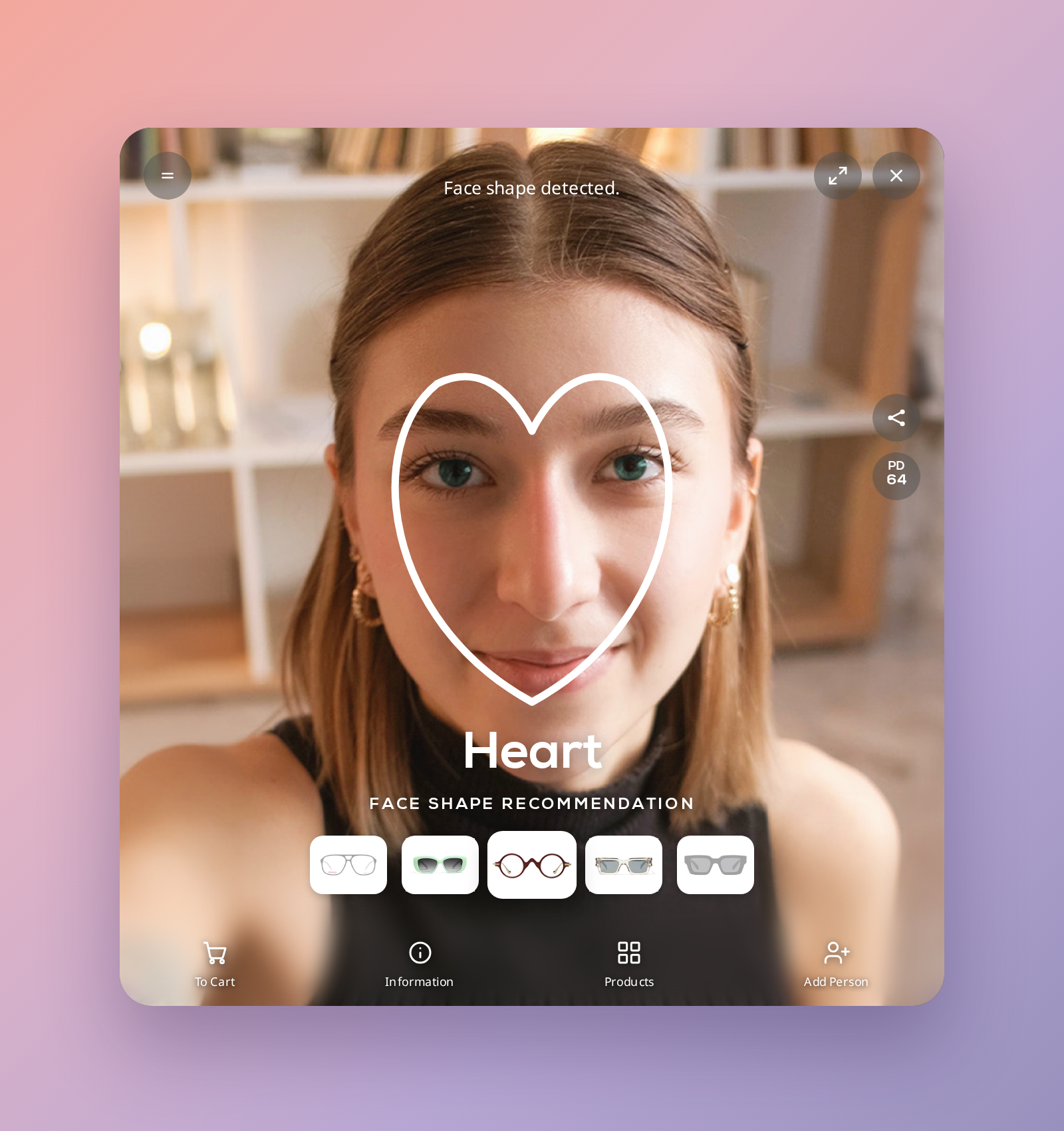
Solving the Shape Question requires four things to happen together. Face shape needs to be detected accurately and presented to the shopper without making them measure themselves. The catalogue needs to be filtered through that detection in a way that surfaces frames the shopper would not have chosen on their own. The recommendation logic needs to speak in shopper language - what will suit you - not in optician language - 52-18-140 keyhole bridge. And the try-on needs to follow the recommendation, so the shopper sees themselves in the frames the store has already decided are worth their time.
Auglio's virtual try-on for eyewear is built around this sequence. Face shape detection runs in seconds. Frames are filtered for the shopper before they are filtered by them. The recommendation is shown alongside the try-on, so the recommendation logic is visible and reversible. The shopper stops browsing inventory and starts evaluating themselves in frames the store has already vetted for them. The Shape Question is answered before it has to be asked.
This is what changes when the category stops showing and starts translating. Brands that close this gap typically see conversion lift of 15 to 30 percent on top of any virtual try-on baseline - because the lift does not come from the try-on. It comes from the shoppers who would not have made it to the try-on at all.
The future of buying glasses online is not in the try-on. It is in answering the question shoppers ask before the try-on opens.
What This Means for Your Store
There is a test worth running on your store this week. Open it on your phone, as a shopper would. Go to the collection page for prescription frames or sunglasses. Look at the first twelve frames in the grid.
Now ask yourself the Shape Question, honestly. Which of these will look right on your face? If you can answer it in under thirty seconds without already knowing your own face shape and the rules that go with it, your store has done the translation work. If you find yourself stalling - if you scroll past most of the twelve because you cannot tell which ones are for someone like you - that is the moment your shoppers are stalling too. They are not bouncing because the frames are wrong. They are bouncing because the store has handed them the work that the store should be doing.
If your eyewear store shows inventory but does not translate it for the shopper, you are losing high-intent buyers in the silence before the first try-on - and you are not seeing it in your dashboard.
The brands that close this gap are not just adding a feature. They are removing the hardest cognitive work from the front of the journey, so the shopper can spend their attention where it actually converts - on the frames that have already been chosen for them. Hesitation has a shape. The future of online eyewear is built around removing it.
We can show you exactly what the Shape Question looks like in your store, and what closing it typically does to improve eyewear e-commerce conversion.
Tags: Eyewear Face Shape E-commerce conversion Eyewear e-commerce Customer confidence Buying glasses online Face Shape Detection