
Apr 20, 2026
Eyewear E-Commerce · Product Insight
The Realism Problem: Why Virtual Try-On Feels Wrong to Eyewear Shoppers Even When It Works
The subtle signals that break trust in virtual try-on - and why technical accuracy is not what drives eyewear e-commerce conversion.
Most virtual try-on experiences do not fail because they are inaccurate.
Not because tracking is broken. Not because rendering is poor.
They fail because something in the image feels off - and that feeling is enough to stop the purchase.
This is what we call the realism problem.
For eyewear e-commerce teams, this creates a hidden conversion gap. High-intent shoppers researching buying glasses online open the try-on experience, see a version of themselves that does not quite look right, and quietly leave. Not because the tool is broken. Because it is not believable.
The realism problem refers to the gap between technical accuracy and perceived believability in virtual try-on. A try-on can be technically correct in every measurable way and still feel wrong to the shopper - and in eyewear e-commerce, the shopper who does not trust what they see does not buy.
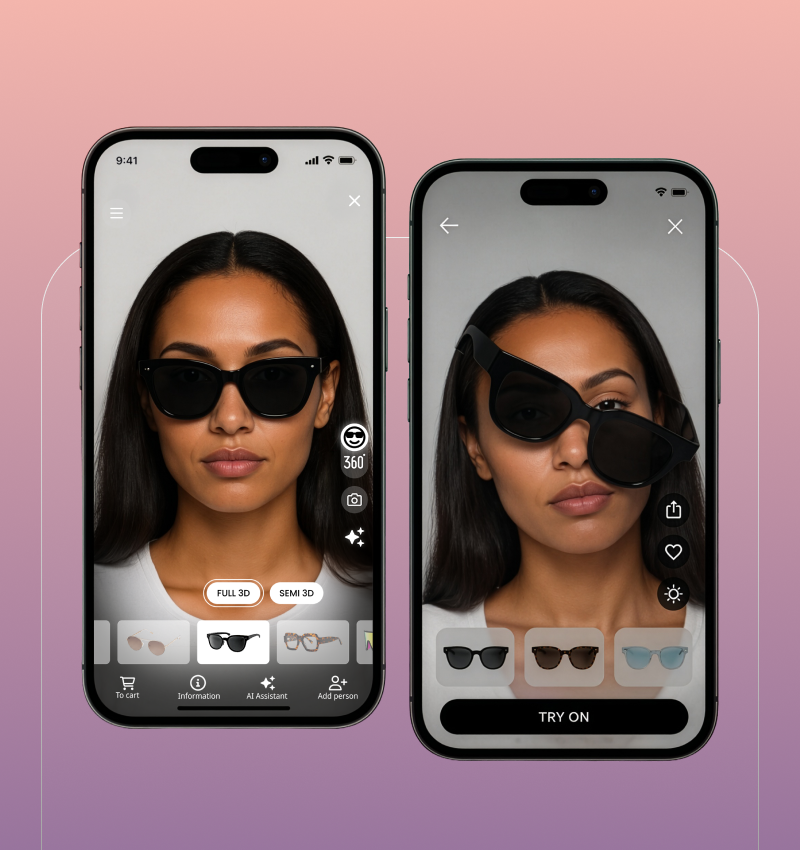
The Hidden Realism Gap
There is a moment that happens quickly in eyewear e-commerce. A shopper opens a virtual try-on experience, looks at themselves wearing a new pair of frames, and pauses.
Not because they cannot see the product. Not because they cannot navigate the experience. But because something feels off.
They may not articulate what it is. Frames that float slightly away from the face. Proportions that sit just a little too large or too small. Lighting that does not match the room they are in. A subtle distortion at the temples or the nose bridge. None of these signals need to be extreme to matter.
Because eyewear is not just a product. It is a self-image decision. And self-image decisions require belief in what you are looking at. If the image is not believable, the decision does not happen.
“I’m concerned that the virtual try-on is making something look good that won’t work.” - eyewear shopping communities online
This is the realism problem in its simplest form. Not that the try-on is broken. The try-on is convincing in the wrong direction - and the shopper knows it.
Why does virtual try-on feel wrong even when it is accurate?
Most virtual try-on platforms are built and measured around accuracy.
But from a shopper's perspective, accuracy is not what drives confidence.
Believability is.
Industry research suggests roughly 70% of online eyewear shoppers hesitate at the point of purchase because they are not sure how frames will look on them. The try-on image exists specifically to resolve that hesitation - and when it is not believable, it does not.
A try-on can be technically correct in every measurable way and still produce an image the shopper does not trust. The frame coordinates are right. The tracking is stable. The render is clean. And yet the shopper looks at themselves and thinks: this does not look like me wearing these glasses. That feeling is not a measurement error. It is a perceptual signal, and it is what most accuracy-focused platforms are not built to solve.
The realism problem is most acute in premium eyewear.
Hesitation on a 40 GBP frame is friction. Hesitation on a 400 GBP frame is a lost conversion.
A premium buyer will not commit to a 400 GBP decision based on a try-on that looks almost right.
In eyewear e-commerce, the biggest barrier to conversion is not accuracy. It is believability.
Why does the realism problem go unmeasured in eyewear e-commerce?
The conversion impact of the realism problem is real, but it is difficult to measure directly - because it shows up as absence rather than as data.
Shoppers who do not trust what they see in the try-on do not report it. They do not file a support ticket. They do not explain in an exit survey that the experience did not look believable. They simply bounce. The gap between your traffic and your conversion rate quietly absorbs them.
This is why virtual try-on often fails to improve eyewear e-commerce conversion in the way retailers expect, and why many brands still struggle to reduce cart abandonment in eyewear e-commerce despite having a try-on feature live on their product pages. The feature works. The shoppers are using it. But the image is not convincing enough to close the decision.
There is a secondary effect. Shoppers who push through a try-on that feels wrong and purchase anyway are buying with uncertainty. They are not confident. They are guessing. And shoppers who guess at checkout are the shoppers who open the box a week later and send the product back. The realism problem does not just suppress conversion. It inflates returns.
Industry estimates put online eyewear return rates at 15-20%, with fit and style mismatch cited as the dominant reasons. A meaningful share of those returns are shoppers who saw a version of themselves in the try-on that did not match the version that arrived in the box.
Price optimisation addresses a small part of eyewear hesitation. Confidence drives the majority of buying decisions. Realism is the layer that builds it.
How does realistic virtual try-on actually work?
Improving virtual try-on is not about improving rendering alone. It is about removing the subtle signals that break trust. That requires four things to hold together at the same time.
Frames need to sit naturally on the face - resting where real frames would rest, at the bridge and the temples, not floating or sinking into the skin. Scale needs to feel correct relative to the shopper's actual facial proportions, not a generic average. Lighting needs to match the environment the shopper is in - warm light in a warm room, cool light in a cool one - so the frames look like they belong on the face, not pasted onto it. And the experience needs to be stable: no jitter, no lag, no frames jumping between positions when the shopper moves.
When those four elements align, something changes in the experience. The shopper stops evaluating the technology. They start evaluating themselves in the product. That shift is where confidence begins, and it is the shift most accuracy-focused try-on tools never make.
This is what Auglio’s virtual try-on for eyewear is built for. The goal is not to demonstrate technical capability on a face. The goal is to produce an image the shopper actually trusts - the image that lets them make the decision.
Virtual try-on does not fail because of technology. It fails because it ignores how people actually evaluate themselves.
What This Means for Your Store
If you have virtual try-on on your product pages, there is a straightforward test worth running this week. Open your store on your phone. Try on three or four frames from your own catalogue. Pay attention not to whether the experience works, but to your first reaction when you see yourself wearing each pair.
The question is not: does it track? The question is: does it look like me wearing these glasses?
If there is a moment of hesitation in your own reaction - a small feeling that the image is not quite right - your shoppers are having the same reaction. And they are not telling you about it. They are closing the tab.
If your virtual try-on is not believable, it is not building the confidence your customers need to buy. It is a feature that loads, not a feature that converts.
The brands that close this gap are not just improving a feature. They are removing an invisible barrier between the shopper and the decision. That compounds: fewer abandoned sessions, fewer low-confidence purchases, fewer returns, more customers who come back because the experience actually worked for them.
If your virtual try-on does not feel believable to the shopper looking at it, you are losing high-intent buyers without visibility.
We can show you exactly what that gap looks like in your store - and what closing it typically does to improve eyewear conversion and reduce returns.
→ Book a demo at auglio.com/en/contact
Tags: Eyewear E-commerce conversion Virtual try-on Eyewear e-commerce Customer confidence Virtual try-on realism