
Eyewear E-Commerce · Product Insight
The Invisible Glasses Problem: Why Virtual Try-On Fails the Shoppers Who Need It Most
The structural flaw in most virtual try-on experiences - and why the shoppers most likely to buy glasses online are often the ones it is least designed for.
Most virtual try-on experiences fail at the moment they are supposed to work.
Not because of accuracy. Not because of design.
Because a significant portion of eyewear shoppers literally cannot see the screen when using them.
This is what we call the invisible glasses problem.
For eyewear e-commerce teams, this creates a hidden conversion gap. High-intent shoppers researching buying glasses online enter the funnel, but a portion cannot meaningfully use the try-on experience - and leave without explanation.
The Invisible Glasses Problem refers to a structural flaw in virtual try-on where users must remove their glasses to use the experience - preventing them from accurately evaluating frames and reducing confidence to purchase. In eyewear e-commerce, the shoppers who most need virtual try-on are often the ones it is least designed for.
The Hidden Conversion Gap
Most virtual try-on experiences are built around a single assumption: that the shopper has removed their glasses before starting.
In practice, this means standard virtual try-on experiences are not fully usable for a significant portion of glasses wearers.
For a significant proportion of eyewear shoppers, that assumption creates a fundamental barrier. If your prescription is strong enough that you cannot function comfortably without your glasses, removing them to try on new frames means you cannot see the screen clearly enough to evaluate what you are looking at.
The experience breaks at the first step. The shopper either abandons immediately, or they complete the try-on with their vision impaired - squinting at a blurry version of themselves, unable to assess whether the frames actually suit them. In both cases, the tool designed to build confidence has instead introduced a new source of frustration.
“I can’t do virtual try-on because I have to take my glasses off and then I can’t actually see the screen properly.” - eyewear shopping communities online
This is the invisible glasses problem - and it is hiding in plain sight.
Why does virtual try-on fail for glasses wearers?
It is tempting to assume that shoppers with strong prescriptions are a small minority. The data suggests otherwise.
Globally, over 60% of adults require vision correction, according to industry estimates. This means a significant portion of eyewear shoppers depend on their glasses to function day-to-day.
The people most likely to shop for glasses online are often the ones who most need vision correction - not casual buyers experimenting with a style change, but regular glasses wearers who replace their frames every one to three years. These are high-intent, repeat buyers. They know what they need. They are comfortable with e-commerce. And a significant proportion of them have prescriptions strong enough that removing their glasses is not a minor inconvenience - it is genuinely disorienting.
The confidence gap in eyewear e-commerce is not just about hesitation. For a meaningful portion of shoppers, it is about literal inability to use the tools designed to resolve that hesitation.
When you design a virtual try-on experience that requires glasses removal, you are not building a universal solution. You are building something that works well for shoppers with mild or no prescription - and excludes the core of your high-frequency buyer base.
For most eyewear e-commerce teams, this is not a feature gap. It is a revenue gap hiding inside the experience.
Why does this problem go unmeasured in eyewear e-commerce?
The conversion impact of the invisible glasses problem is real, but it is difficult to measure directly - because it shows up as absence rather than as data.
Shoppers who cannot use the try-on feature do not leave a trace of why they left. They do not file a support ticket. They do not explain in an exit survey that the experience did not work for them. They simply bounce. The gap between your traffic and your conversion rate quietly absorbs them.
This explains why virtual try-on often fails to improve eyewear e-commerce conversion - and why many retailers still struggle to reduce cart abandonment in eyewear e-commerce despite offering it.
More broadly, this highlights a common issue in e-commerce: tools designed to increase conversion often fail because they do not match how customers actually make decisions.
There is a secondary effect too. Shoppers who push through the experience with impaired vision - squinting at a blurry screen - are completing the try-on without genuine confidence. They are going through the motions. And a try-on that does not build confidence does not drive conversion. Worse, it can increase returns, because the shopper who purchases without clarity is the shopper who opens the box and thinks: “this is not what I expected.”
Price optimisation addresses a small part of the problem. Confidence drives the majority of buying decisions. The invisible glasses problem sits inside that gap.
How does invisible glasses technology work?
The solution is not a workaround. It is a design decision made at the foundation of how virtual try-on works.
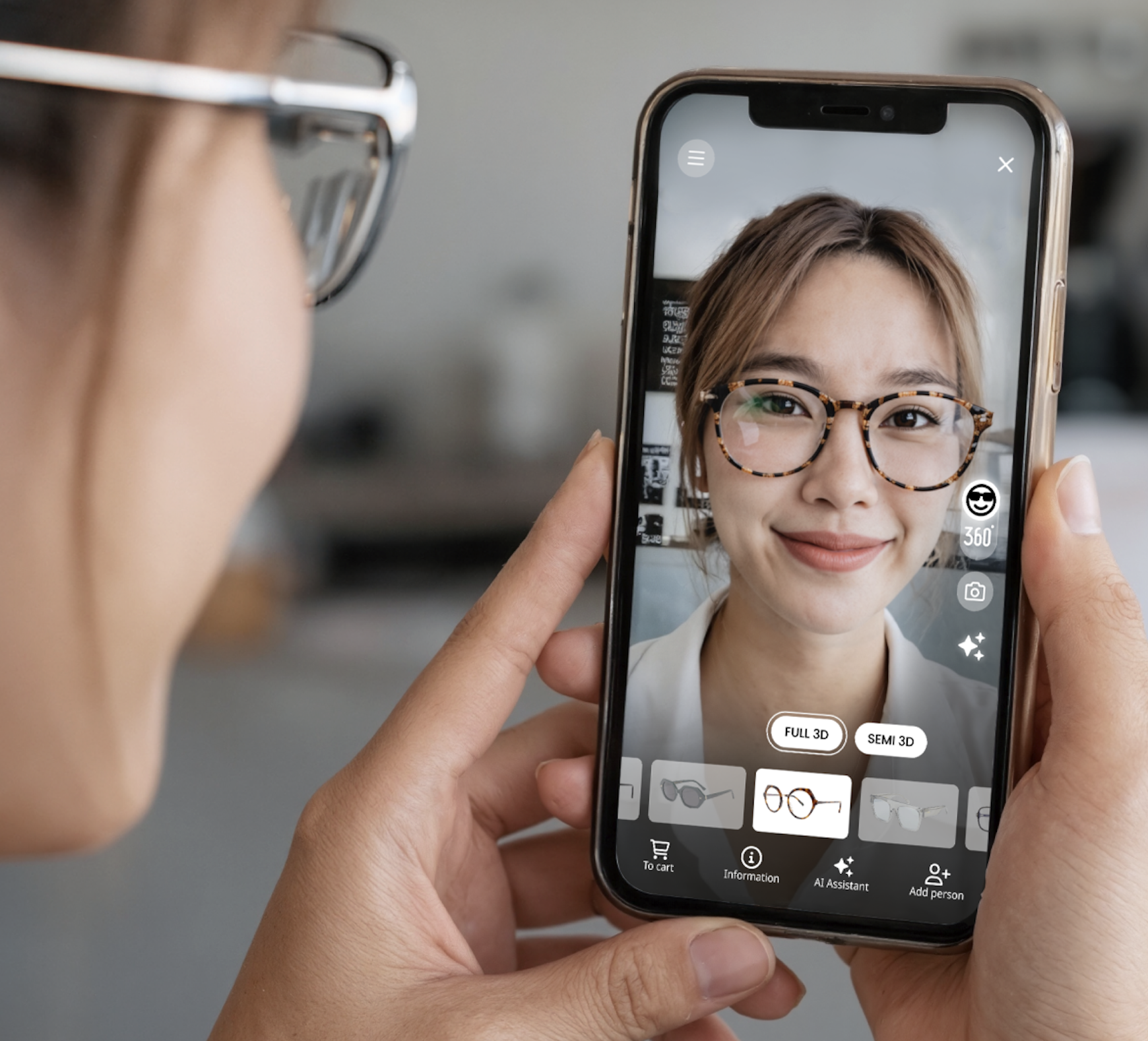
Instead of asking the shopper to remove their glasses and hope they can navigate the experience without them, the technology detects and digitally removes the existing frames in real time - using computer vision to identify the current glasses on the shopper’s face, strip them away cleanly, and overlay the new frames as if neither pair was ever there.
The result is an unobstructed, realistic try-on experience for shoppers who wear glasses - without requiring them to remove the very thing that allows them to see. The shopper does not need to think about their prescription. They just try on frames, the same way a shopper without glasses would.
This is what Auglio’s Invisible Glasses feature does. It is live in production, used by eyewear retailers including Zoff in Japan - one of the country’s largest eyewear brands - and built specifically to address the segment of the market that standard virtual try-on cannot reach.
Virtual try-on does not fail because of technology. It fails because it ignores how people actually see.
What This Means for Your Store
If you have virtual try-on on your product pages, there is a straightforward question worth asking this week: does it work for shoppers who are wearing glasses when they start the experience?
The easiest way to test this is to open your store on your phone, put on a pair of glasses if you wear them, and go through the try-on process without removing them. What does the experience show? Does it detect and remove your existing frames? Or does it produce a cluttered, unrealistic overlay that would push any shopper toward abandonment?
If your virtual try-on cannot handle the shopper who is already wearing glasses, you have a conversion gap you have likely never measured - because the shoppers it affects leave without explaining why.
The brands that close this gap are not just improving a feature. They are removing an invisible barrier for their highest-intent buyers. That compounds: fewer abandoned sessions, fewer low-confidence purchases, fewer returns, more customers who come back because the experience actually worked for them.
If your virtual try-on does not work for shoppers already wearing glasses, you are likely losing high-intent buyers without visibility.
We can show you exactly what that gap looks like in your store - and what closing it typically does to improve eyewear conversion and reduce cart abandonment.
→ Book a demo at auglio.com/en/contact
Tags: Eyewear Invisible Glasses E-commerce conversion Virtual try-on Eyewear e-commerce Customer confidence